
Máni : a new mission to explore the Moon
Credit: Space Inventor
The Máni Mission is a lunar mission that will use a satellite to map the Moon’s surface with high-resolution images and create detailed 3D maps of the Moon’s terrain. This will make it easier for astronauts and lunar rovers to land and navigate on the Moon. The satellite will orbit the Moon’s north and south poles, which are key areas for the ambition to send astronauts back to the Moon. In addition, the mission will map in detail how light is reflected from areas on the Moon that are used to study Earth’s ability to reflect sunlight onto the Moon’s surface—the so-called Earthshine. This knowledge can help improve our understanding of how Earth’s climate will develop. The University of Copenhagen is leading the mission and is responsible for the mission’s “science operations center,” which will plan which areas to map and analyze the many images generated by the mission. The mission was officially approved by ESA in December 2025. The satellite is scheduled for launch in 2029.
The University of Copenhagen heads an international consortium of Danish and international research institutions and industry partners. At the University of Copenhagen, the Globe Institute, the Niels Bohr Institute, and the Department of Computer Science are responsible for leading the mission and processing the data generated by the Máni Mission. Academic partners include Aalborg University, Aarhus University, and the University of Southern Denmark, as well as DMI, the Polish Academy of Sciences (Polska Akademia Nauk), and the French university Université Paris-Saclay. Danish company Space Inventor is the mission’s primary industry partner and will build the satellite and install the instruments and components provided by the mission’s Polish, Dutch, and Slovenian industry partners.
My group will bring a general planetary science expertise, to build up the mission and the instrument and to select the lunar target. In addition, we will be in charge of the software development, especially for the photometric technique.
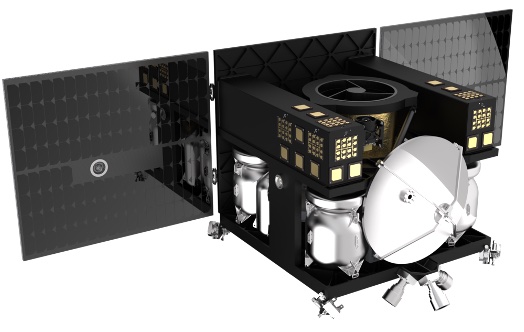
Artistic view of the Máni spacecraft. Credit: Space Inventor